Blog
Evidence-based impact of MMF’s Conflict Management Programme
Conflict in paediatric healthcare is costly for families, for staff and for NHS budgets. But can training healthcare teams to recognise and manage conflict achieve measurable and sustainable change?
Independent, peer-reviewed research on the impact of The Medical Mediation Foundation’s Conflict Management Programme (CMP) published today says yes.
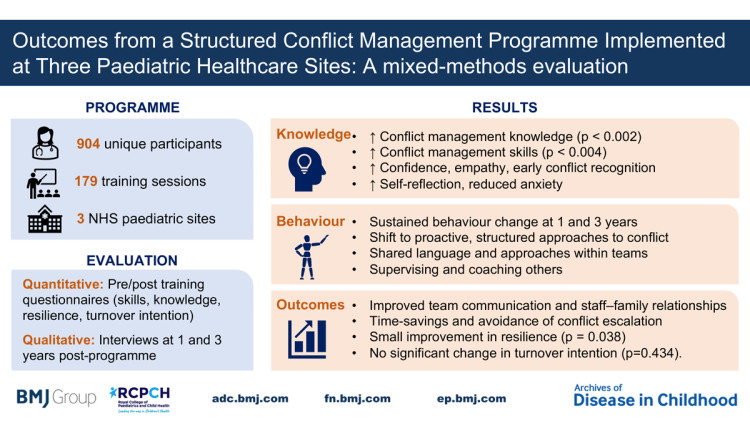
The research, published in Archives of Disease in Childhood, evaluated the impact of the CMP, delivered at three specialist NHS children’s hospitals over a three-year period. In total, 904 staff were trained to recognise and manage conflict using a structured framework.
This paper is the latest in a growing body of independent research on MMF’s work - adding to an evidence base built over 15 years with more than 12,000 healthcare professionals trained.
Key findings
- Staff maintained proactive, structured approaches to conflict at three-year follow-up
- Teams built a shared language and culture around early conflict recognition
- At some sites, legal escalation was avoided - directly attributed to the programme
- Staff-family relationships and workplace culture improved across multidisciplinary teams
Impact of the programme:
The research found the CMP demonstrated lasting, measurable organisational change, based on the Kirkpatrick Model for evaluating learning:
“The majority of conflict management training evaluations in healthcare fail to assess impact beyond Kirkpatrick level 2. In contrast, this evaluation incorporates mixed-methods, longitudinal qualitative data and captures Kirkpatrick Level 3 and 4 outcomes, strengthening the validity of the findings and demonstrating a more methodologically sound approach than is typical in the conflict management training literature.”
Impact on clinical teams:
Developing a shared language and consistent framework helped unify team responses to conflict and supported a culture shift away from labelling families as ‘difficult’
What participants said:
One doctor reported that after three years: ‘We talk about conflict much more, instead of it being a hidden thing. Instead of it being something that was too difficult to deal with, people just call it out for what it is.’
And a senior physiotherapist said: ‘We could have ended up in court with this family but we didn’t. I see that as a success because of the conflict management training.’
What determined success?
The sites that embedded the programme most effectively shared three characteristics: senior leadership commitment, protected training time, and integration into existing governance and staffing structures. Sites where those conditions were absent saw more limited impact.
Read more about the MMF Conflict Management Programme
Get in touch to discuss implementing the MMF Conflict Management Programme within your organisation
 RSS
RSS