Blog
Why it feels hardest to listen well when it matters most – and how to bring our thinking brain back online
by Dr Esse Menson, MMF Senior Mediator and Trainer
We’ve probably all been there. Someone says something that feels unfair, critical or challenging. We feel misunderstood, blamed or perhaps powerless. Our heart beats a little faster, our shoulders tighten, and before we know it, we’re preparing our defence rather than listening. We might interrupt, withdraw, become defensive or find ourselves repeating the same point more forcefully. And afterwards, we wonder: Why didn’t I handle that better?
The answer may have less to do with our communication skills than with what happens in our brain when we feel threatened.
When our brain tries to protect us
Our brains are remarkably good at detecting danger, and the threat doesn’t have to be physical. Feeling criticised, challenged, undermined or powerless can also trigger a stress response. And when that happens, the very abilities we need to navigate situation – listening well, curiosity, flexible thinking, perspective-taking and good judgement - can become harder to access. And previous experiences can amplify this response.
A healthcare professional who is being publicly criticised may become defensive when their judgement is questioned. A parent who feels their child has experienced failures in care may be especially alert to signs that something is being missed again. Neither response necessarily means someone is being unreasonable; sometimes the threat is real. But what is happening now may also be interacting with what happened before.
Use B.R.A.I.N.
Try using our simple, evidence-informed practice which helps us recognise what’s happening and give ourselves a better chance of responding thoughtfully rather than reacting automatically.
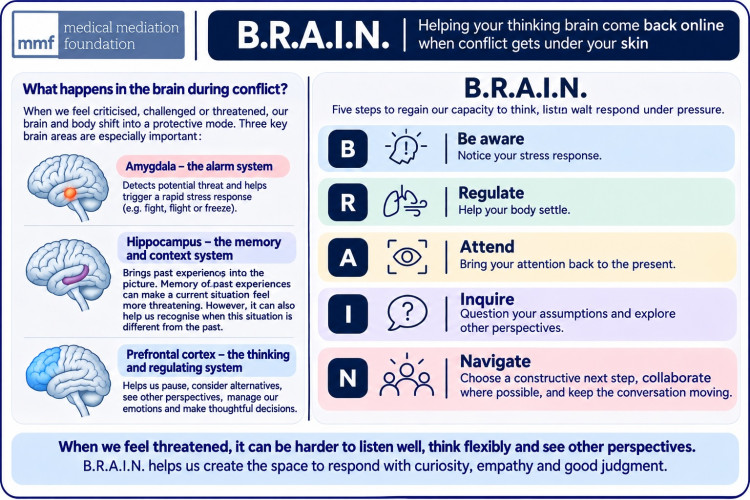
B - Be aware
Notice your stress response. What’s happening in your body? Are you becoming defensive, anxious or increasingly certain you’re right?
R - Regulate
Help your body settle. Relax your shoulders, feel your feet on the floor, slow your breathing. Sometimes a brief pause is enough.
A - Attend
Bring your attention back to the present moment. What has the other person actually said? Are you listening to understand, or preparing your response?
I - Inquire
Become curious. What am I assuming? What if my first interpretation isn’t the whole story? What else might explain this person’s behaviour?
N - Navigate
Choose your next step. What would help most right now? Listening longer? Acknowledging their concerns? Asking open questions? Setting a boundary? Taking a break?
It’s not about being calm at all costs
B.R.A.I.N. isn’t about suppressing feelings, avoiding disagreement, appeasing or accepting unacceptable behaviour. We can remain compassionate and curious while disagreeing, challenging, setting clear boundaries or making difficult decisions.
Nor is it a magic solution to conflict. It’s a practical way to create a little more space between what we feel and what we do next. And sometimes that small space can make a remarkable difference.
Notice. Settle. Listen. Get curious. Choose.
Perhaps the first step towards a better conversation is to pause our search for the words that will change the other person’s mind and make room to hear what we may have missed.
Download the full article with reference pack
Download and save the infographics B.R.A.I.N Healthcare and B.R.A.I.N Conflict Response
 RSS
